


Ambient AI documentation for a multi-specialty care network
Clinicians spent hours a day on notes instead of patients. We built an ambient layer that captures the visit and drafts the chart before the room is empty.
Project Description
The challenge
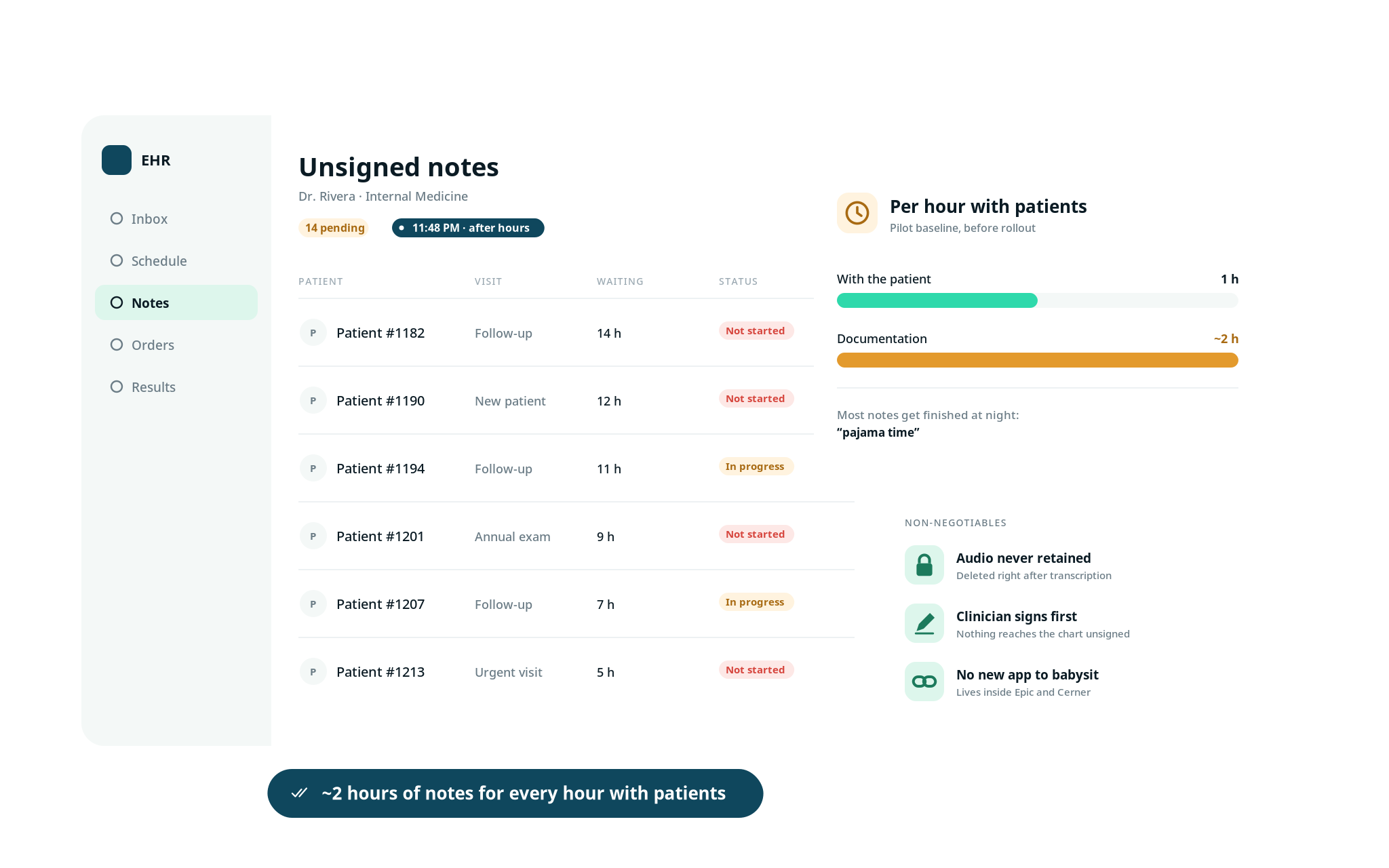
Physicians were logging close to two hours of documentation for every hour spent with a patient — what the industry has started calling “pajama time,” since that's often when the notes actually get finished. The client didn't want another app for clinicians to babysit. They wanted something that could capture the visit itself, turn it into a structured SOAP note, and push it straight into Epic and Cerner.
The hard constraint was trust. Nothing was allowed to reach the chart without a clinician signing off first, and raw audio couldn't stick around past the transcription step - not even for a day.
Solution
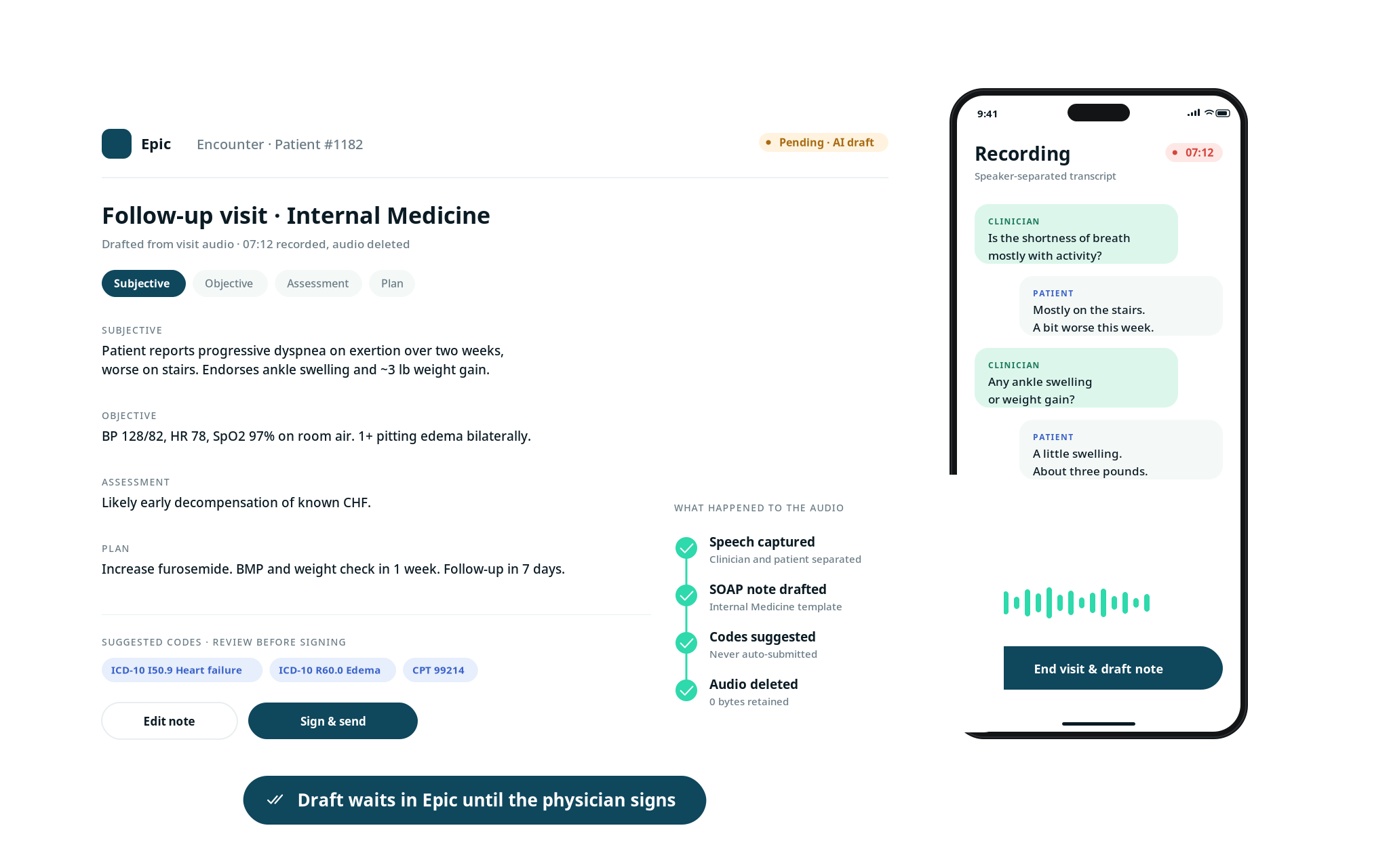
Our answer was a mobile ambient-listening app paired with a speech pipeline tuned for clinical language, one that can tell the clinician's voice from the patient's. An LLM layer then shapes that transcript into a specialty-specific SOAP note, complete with draft ICD-10/CPT suggestions attached — never auto-submitted, always waiting on a human.
Drafts land inside Epic and Cerner as pending encounters, delivered over an HL7/FHIR interface, so the physician reviews, edits, and signs from the same screen they already use. The audio doesn't survive the transcription step — once the text exists, the recording is gone, and only the encrypted note remains.
Our approach
- Clinical workflow shadowing - Sat in on real visits across three specialties to map where documentation actually breaks down, not where we assumed it would.
- HIPAA-first architecture - Designed the data path - audio in, structured text out, nothing retained - before any model work started.
- ASR & note-template prototyping - Tuned the speech pipeline and built specialty-specific SOAP templates with input from practicing clinicians.
- Epic & Cerner sandbox integration - Built the FHIR interface for draft-encounter delivery and physician sign-off inside the existing EHR, not a separate screen.
- 15-clinician pilot - Ran a closed pilot, tuned acceptance-rate issues by specialty, then staged the rollout clinic by clinic.
Tech stack
We deliver technology-driven projects that solve real business challenges, improve efficiency, and enable digital growth.
Frontend
React.js
TypeScript
Backend
Python
Node.js
PostgreSQL
AI-layer
ASR
LLM
Infrastructure
Docker
Kubernetes
AWS
Integrations
HL7/FHIR
The result
- Per-visit documentation time fell from roughly 9 minutes to about 3, measured across the pilot cohort by the third week of use.
- AI-drafted notes reached a 92% acceptance rate with only minor physician edits — up from 78% before the templates were tuned by specialty.
- The rollout reached 40+ clinics within six months of MVP sign-off, beating the client's original phased timeline.
- Zero PHI security incidents, and a clean third-party HIPAA audit before the first clinic ever went live in production.