


Virtual queuing and automated recall for the emergency department
Stable ED patients were spending hours in crowded waiting rooms or leaving before treatment. We built a virtual queue that predicts callback times, automates recall, and keeps staff in control.
Project Description
The challenge
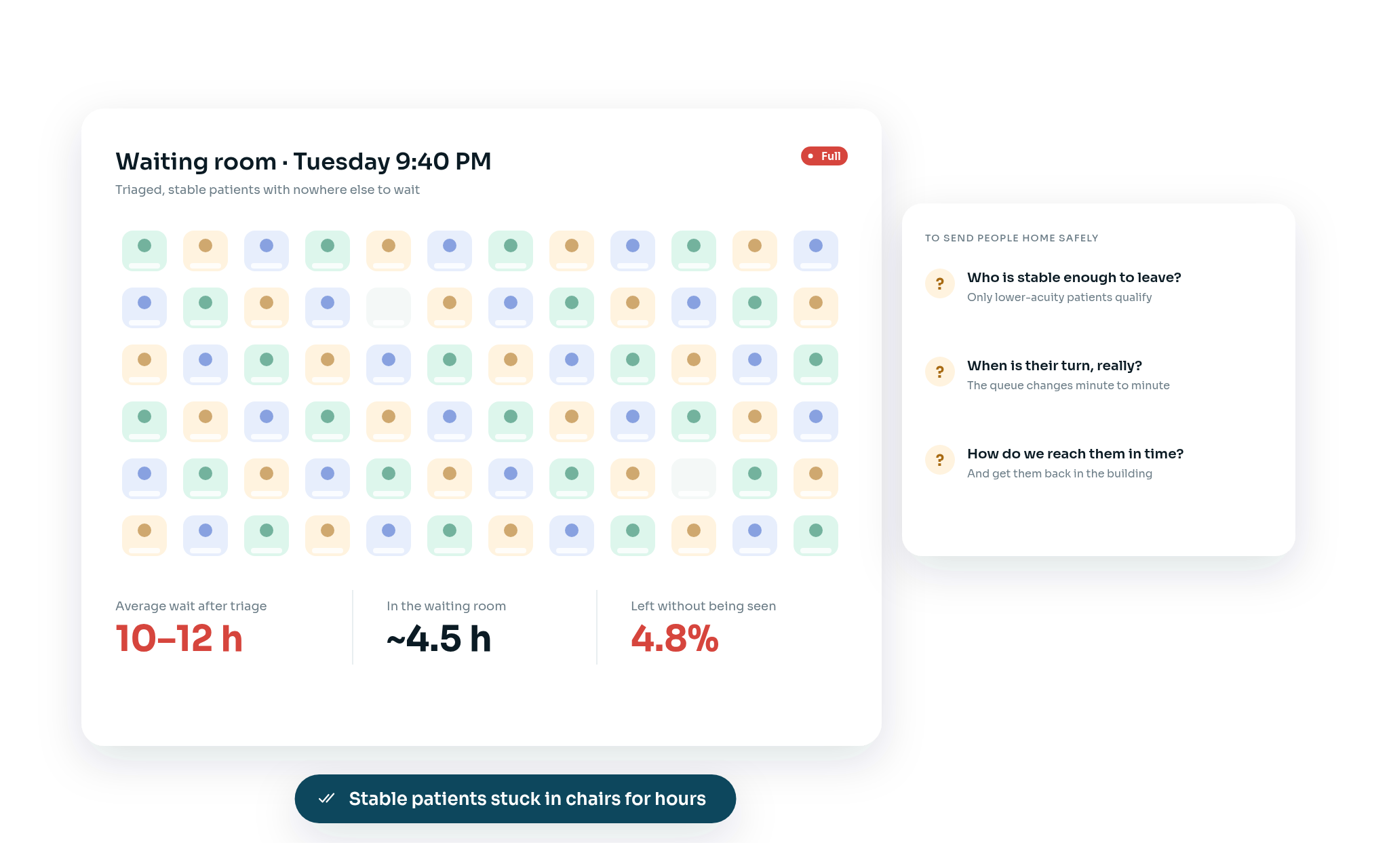
Walk into most emergency departments on a bad night and the story is the same: a packed waiting room, a ten- or twelve-hour wait after triage, and patients who've already been assessed as stable sitting there anyway because there's nowhere else the system knows to find them. The client's ED was living that story every shift, and it was showing up in their left-without-being-seen numbers — patients who gave up and walked out before a doctor ever saw them.
The catch is that you can't just tell people to go home and come back. Someone has to track who's stable enough to leave, know when their turn is actually approaching, and be able to reach them fast enough to get them back in the building in time.
Solution
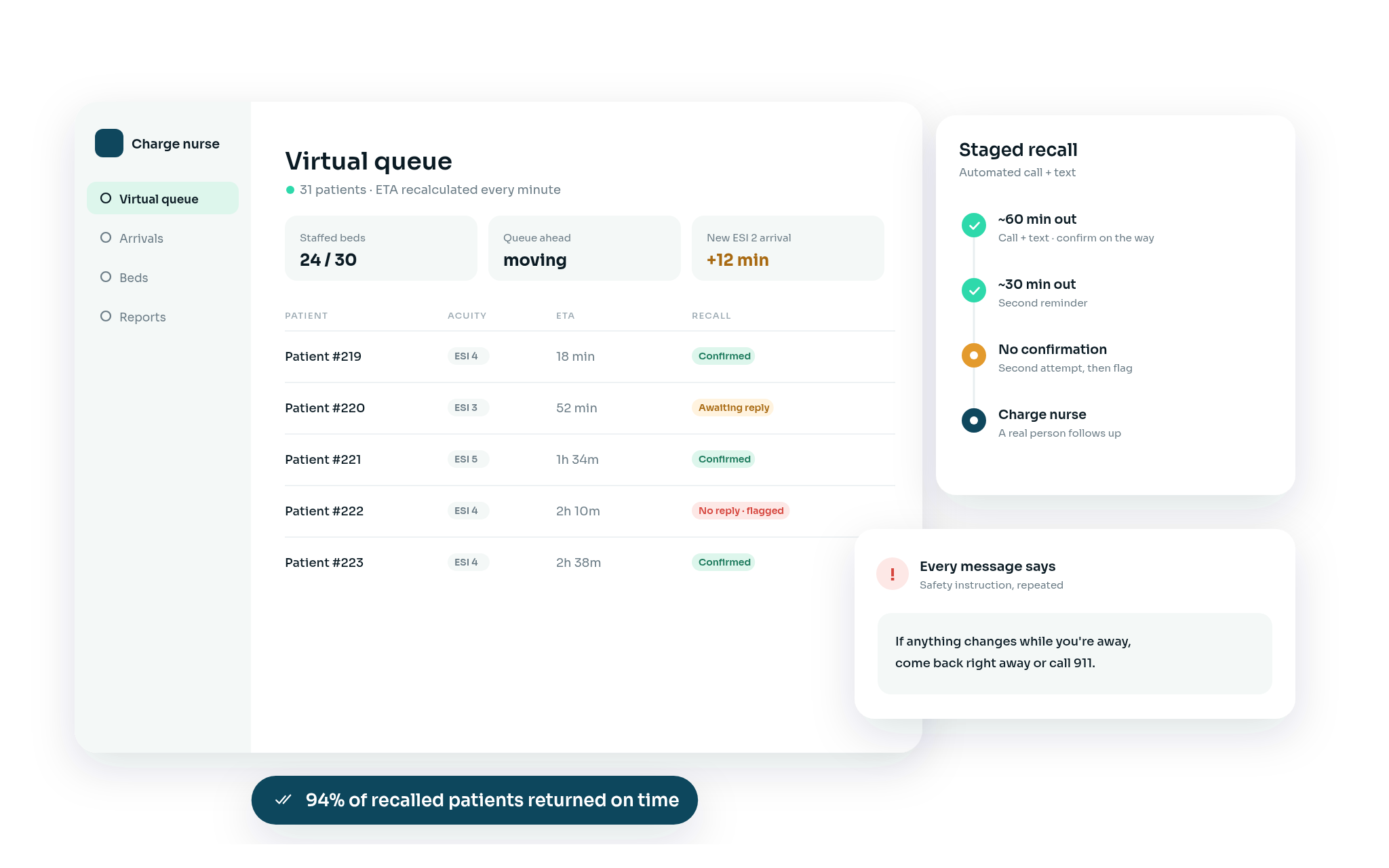
Once a nurse completes the initial triage and assigns an acuity level, eligible patients — stable, lower-acuity cases only — get added to a live queue instead of a waiting-room chair. A prediction model keeps recalculating their estimated call-back time against what's actually happening in the department: how many beds are staffed, how the queue ahead of them is moving, whether a higher-acuity patient just came in and bumped the line.
From there it's a staged recall: an automated call and text roughly an hour out, asking the patient to confirm they're on their way, then another about thirty minutes out. Every message repeats the same instruction — come back right away, or call 911, if anything changes while you're gone. A patient who doesn't confirm gets a second attempt and then a flag on the charge nurse's screen, so a real person follows up instead of the system just guessing.
Our approach
- ED workflow & triage shadowing - Spent time with triage and charge nurses across shifts to see where the current process actually broke down, and which acuity levels could safely leave the building.
- Real-time ETA model - Built the queue-prediction engine against a year of historical census data, then tuned it live against staffed beds, provider load, and incoming acuity.
- Recall & confirmation flow - Designed the staged call/text sequence and the escalation path for a patient who doesn't respond in time.
- Epic ASAP integration - Pulled triage acuity and bed-state data over HL7/FHIR, and pushed queue status back so it's visible where staff already work.
- Single-shift pilot, then full rollout - Ran the queue on one shift and one acuity tier first, fixed what broke, then opened it to the full department.
Tech stack
We deliver technology-driven projects that solve real business challenges, improve efficiency, and enable digital growth.
Frontend
React.js
TypeScript
Backend
Node.js
PostgreSQL
Redis
AI-layer
Python (ETA model)
Infrastructure
AWS (HIPAA-eligible)
WebSocket
Integrations
HL7 / FHIR (Epic ASAP)
Twilio (voice / SMS)
The result
- Time physically spent in the waiting room fell from ~4.5 hours to ~1.2 hours for eligible patients — the rest of the wait now happens wherever they'd rather be.
- 94% of recalled patients confirmed and returned within their assigned window on the first or second attempt.
- The left-without-being-seen rate dropped by roughly two-thirds, from about 4.8% to 1.6% of eligible visits.
- The department now moves close to 120 patients a day through virtual queuing without adding waiting-room capacity.