


Remote patient monitoring for chronic disease management
Care teams were missing warning signs between visits and losing time to manual triage. We built an RPM platform that connects home devices, prioritizes risk, and logs CMS-ready monitoring time automatically.
Remote Patient Monitoring
Category
US, NDA
Client
7 months, ongoing support
Duration
Project Description
The challenge
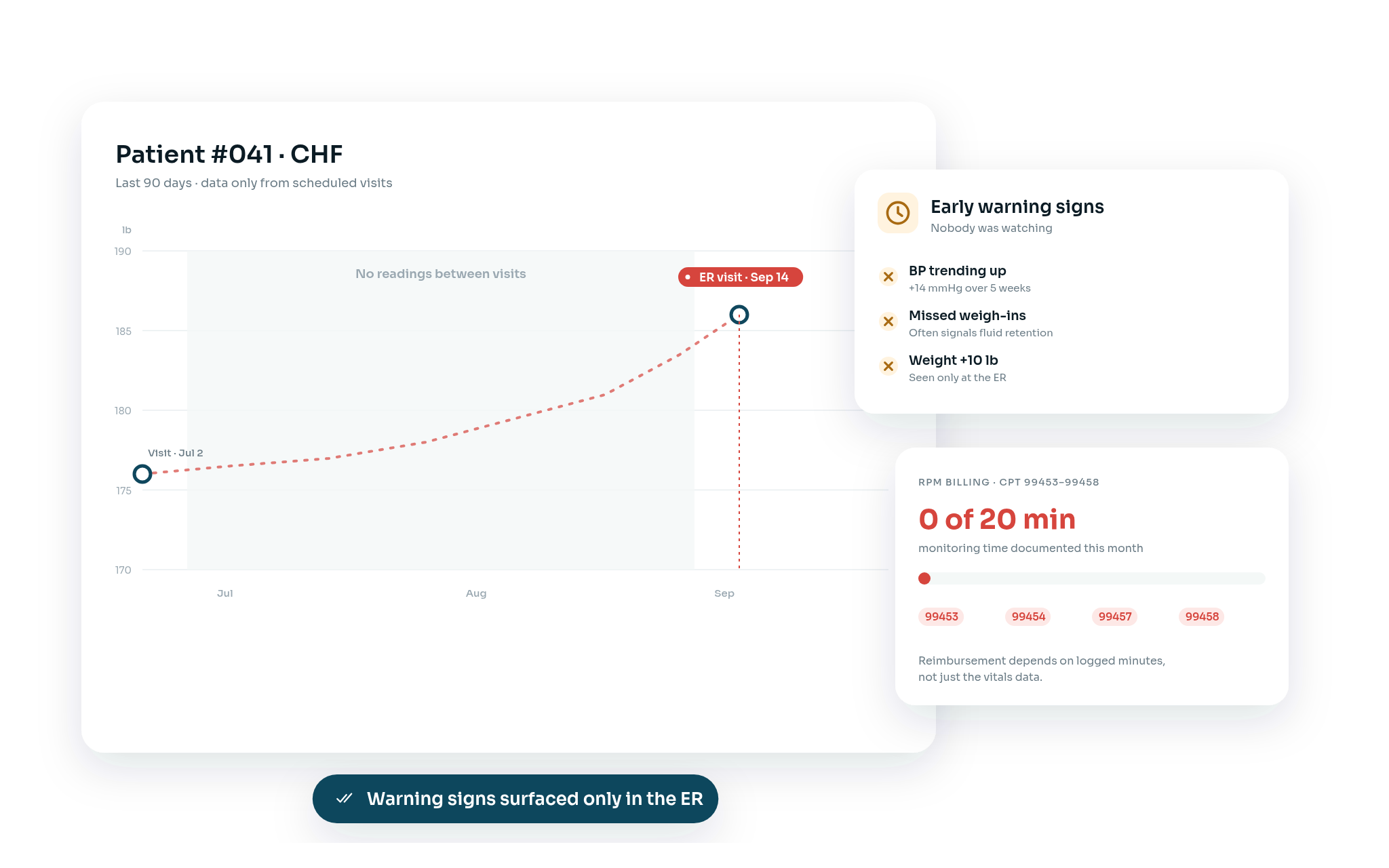
Chronic-disease patients were essentially invisible to the care team outside of scheduled visits. A blood pressure trend creeping upward, a missed weigh-in that usually signals fluid retention in a CHF patient — these went unnoticed until they turned into an ER visit.
There was a billing problem sitting underneath the clinical one, too: RPM/CCM reimbursement under CPT 99453–99458 depends on documented monitoring minutes, not just the vitals data itself, so the platform needed to generate CMS-compliant time logs as a byproduct of normal use rather than a separate chore.
Solution
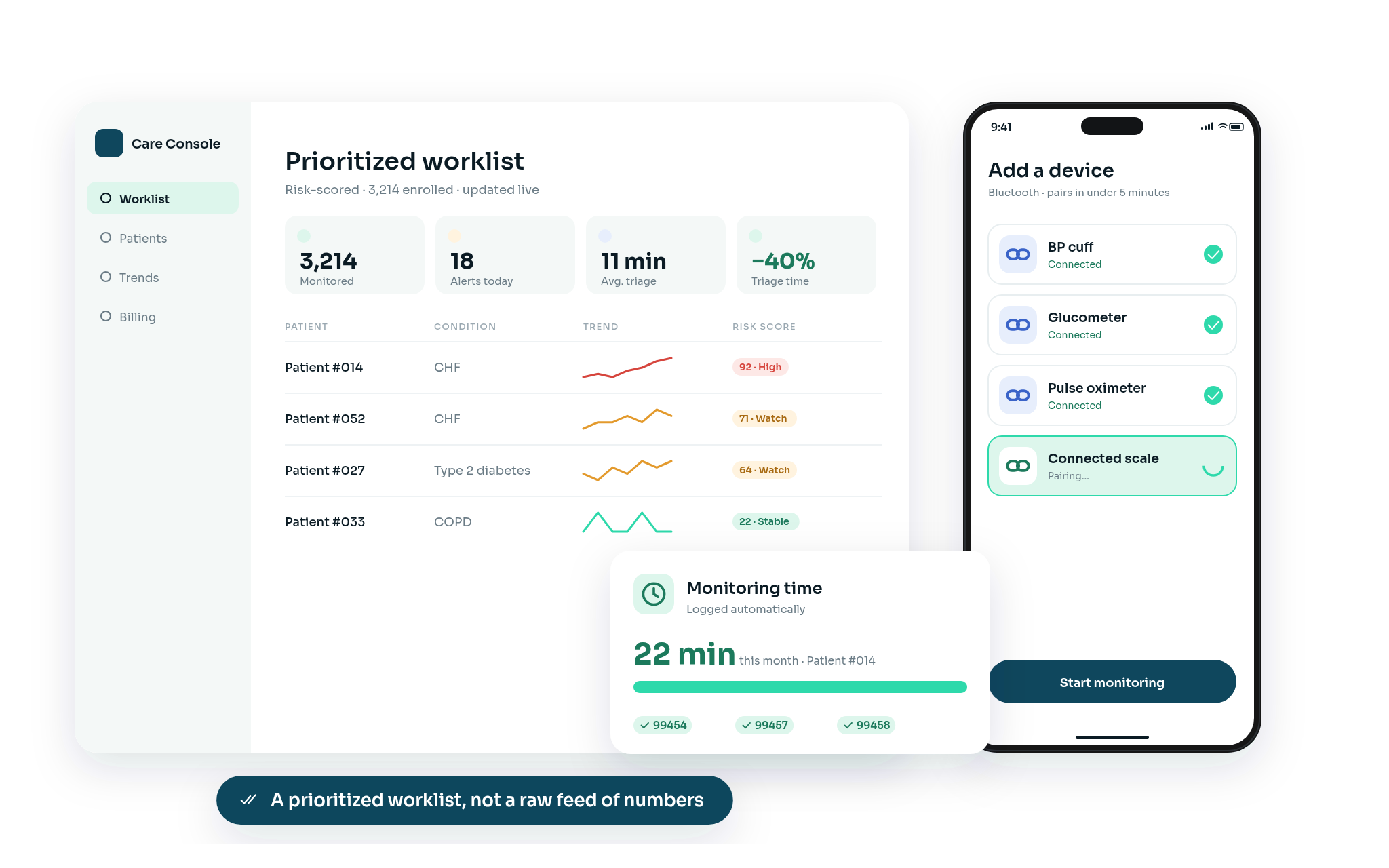
The patient side is a mobile app that pairs Bluetooth vitals devices — BP cuffs, glucometers, pulse oximeters, connected scales — in under five minutes, no tech-support call required. Behind it sits a normalization layer that pulls data from several device vendors into a single time-series pipeline.
A risk-scoring engine, tuned alongside the client's own clinical team, flags anomalies and hands care coordinators a prioritized worklist instead of a raw feed of numbers to sort through. Monitoring minutes get logged automatically against the right CMS billing code as coordinators work each case, so the reimbursement paperwork mostly writes itself.
Our approach
- Care-coordinator discovery - Shadowed the existing manual triage process to find where a raw vitals feed would just create alert fatigue.
- Device-vendor evaluation - Selected and integrated Bluetooth device partners against cost, patient ease-of-use, and clinical accuracy.
- Risk-model design with clinical input - Built anomaly thresholds per condition (diabetes, CHF, COPD) reviewed and signed off by the client's clinical advisors.
- EHR / FHIR care-plan sync - Connected monitoring data and alerts back into the existing EHR so care plans update without duplicate entry.
- 300-patient pilot, then scaled rollout - Validated the risk model and billing workflow on a controlled cohort before opening enrollment further.
Tech stack
We deliver technology-driven projects that solve real business challenges, improve efficiency, and enable digital growth.
Frontend
React Native
React.js
Backend
Node.js (NestJS)
PostgreSQL
TimescaleDB
AI-layer
Python (risk scoring)
Infrastructure
AWS IoT Core
Redis
WebSocket
Integrations
HL7 / FHIR
The result
- Readmissions within 30 days dropped 34% among the enrolled chronic-care pilot cohort, compared with the prior-year baseline.
- More than 3,000 patients were actively monitored within the platform's first year of full rollout.
- Care coordinators cut roughly 40% off their daily triage time once alerts came prioritized instead of raw.
- Accurate CPT 99453–99458 billing gave the client a new reimbursement stream, one documented well enough to survive an audit.