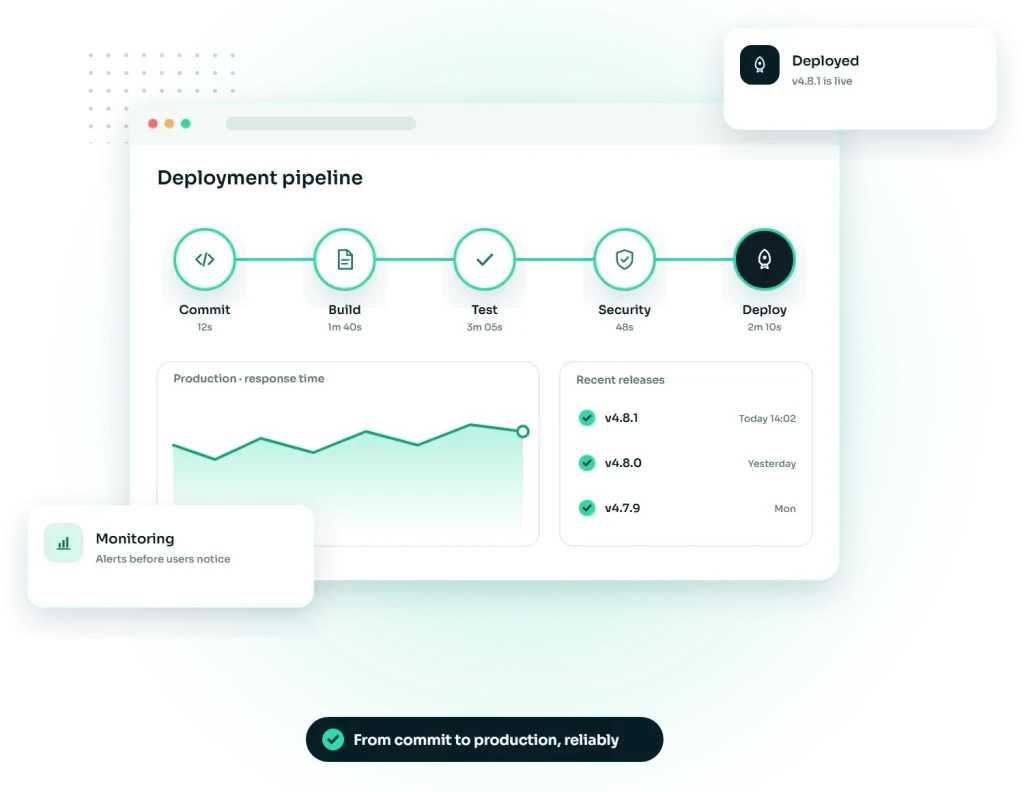
A DevOps assessment follows work from requirement to production, including repositories, builds, environments, approvals, incidents, and ownership. We identify where delivery waits or fails, then rank improvements by business impact and implementation risk.
CI/CD Pipeline Engineering
CI/CD engineering creates repeatable build, test, security, and deployment flows. Pipelines fit the product's release controls and technology instead of copying one template across every repository, environment, and operating team.
Cloud Infrastructure Automation
Infrastructure automation replaces manual configuration with reviewed, versioned definitions. We design cloud environments, networking, identity, policies, backup, and scaling so changes can be reproduced, inspected, and recovered without relying on one operator's memory.
Container and Platform Engineering
Container and platform work may include image standards, orchestration, service configuration, developer environments, and self-service delivery. We introduce Kubernetes or another platform only when its operating value justifies the complexity it adds.
DevSecOps and Compliance Automation
DevSecOps embeds access, secret handling, dependency checks, image scanning, policy, and audit evidence in the delivery flow. Security teams gain visibility without turning every ordinary release into a separate manual project.
Observability and Reliability Engineering
Observability connects logs, metrics, traces, alerts, service levels, and incident response. We reduce noisy signals, define ownership, and build runbooks that help teams detect and recover from real production problems quickly.
Secure DevOps Practices Across the Delivery Lifecycle
01
DevOps security spans source control, build systems, artifact storage, cloud accounts, environments, identities, secrets, networks, and production access. We map trust boundaries and reduce standing privilege. Changes require review, evidence remains traceable, and recovery paths are tested before the delivery platform becomes the route to critical services.
02
AI can assist configuration review, incident analysis, test generation, and documentation. Senior engineers review infrastructure, access, security, and production changes within the agreed scope.
03
Applicable privacy, industry, and contractual requirements become pipeline controls and operating evidence. The final model follows workload risk, cloud provider, jurisdictions, data sensitivity, and the client’s governance needs.
Manual handoffs and inconsistent checks make every deployment a special event. DevOps consultancy services automate repeatable work, define approvals, and keep rollback available, shortening the path to production without removing the controls the business needs.
Inconsistent Environments and Configuration Drift
Infrastructure as code, consistent configuration, versioned images, and managed dependencies reduce differences between development and production. Teams can recreate an environment, review what changed, and fix the system rather than comparing undocumented settings.
Limited Visibility into Production
DevOps consultants connect telemetry to service behavior and ownership. Useful alerts include context, thresholds, and response steps. Noise is reduced so the team can recognize customer impact before dashboards become a collection of ignored warnings.
Cloud Costs Without Clear Ownership
Usage, architecture, capacity, and commercial terms all affect spend. We make cost visible by service and environment, then address idle resources, scaling, storage, data transfer, commitments, and engineering choices without trading away reliability.
Our DevOps Consulting Process
01
Delivery and Infrastructure Assessment
We review repositories, pipelines, environments, infrastructure, access, observability, incidents, release metrics, and team responsibilities. Interviews are checked against configuration and delivery evidence, producing a prioritized view of bottlenecks, risk, and improvement opportunities.
Deliverable:current-state assessment and DevOps risk map.
02
Target Platform and Roadmap Design
The target model defines pipeline stages, environments, infrastructure code, security controls, observability, ownership, and rollout sequence. We choose tools that fit the stack and team, then identify prerequisites, quick wins, and changes requiring careful migration.
Deliverable:target platform design and delivery roadmap.
03
Automation and Pipeline Engineering
Engineers implement pipelines, infrastructure modules, platform services, monitoring, and security controls in reviewable increments. Existing product delivery continues while new paths are tested against representative workloads and teams learn how each part operates.
Deliverable:working automation with documented operating controls.
04
Security and Reliability Validation
We verify builds, deployments, rollback, access, policy, observability, performance, backup, and recovery. Failure scenarios show whether alerts reach the right owner and whether the team can restore service without undocumented manual steps.
Deliverable:verified delivery, security, and recovery evidence.
05
Controlled Rollout and Team Enablement
New pipelines and environments are introduced by service or team, with old routes retained until acceptance criteria are met. Training, runbooks, ownership, and support windows help internal teams adopt the platform without losing delivery capacity.
Deliverable:controlled rollout and team enablement plan.
06
Optimization and Managed Support
After rollout, release data, incidents, cost, reliability, and developer feedback shape the next improvements. Intelisoft can provide ongoing platform support or transfer ownership to the client’s team with a prioritized backlog and clear operational baseline.
Deliverable:operating baseline and DevOps improvement roadmap.
Our clients
Generated over
$50M
in additional revenue for our clients
72%
Faster development with AI-assisted delivery
98%
Client satisfaction rate
Client Testimonials
How Much Do DevOps Consulting Services Cost?
Choose a focused DevOps foundation or a wider cloud delivery transformation. Environments, services, compliance, migration, availability, and support responsibilities determine the final estimate.
DevOps consulting solutions can include delivery assessment, CI/CD, infrastructure as code, cloud and container platforms, DevSecOps, observability, reliability, cost optimization, migration, training, and support. DevOps consultancy services should focus on the actual bottleneck and target operating model, not create a platform the client’s team cannot understand or maintain.
Hire a DevOps consulting company when releases depend on manual work, environments drift, production problems are hard to diagnose, cloud costs lack ownership, or a platform change has stalled. DevOps consulting solutions can address one constraint or support a wider transformation while product teams continue delivering customer work.
Yes. Our engineers review existing pipelines, identify delay and unreliable checks, then improve them incrementally. A DevOps consulting firm may restructure build logic, parallelize tests, introduce caching, strengthen artifacts, and standardize deployment. Changes are measured against release speed, failure rate, recovery, and the team’s ability to support the pipeline.
At enterprise scale, the work addresses delivery and operations across several products, environments, teams, or governance boundaries. A DevOps consulting firm should define platform ownership, access, security controls, service expectations, handover, and ongoing responsibilities. Intelisoft stages the work so useful improvements reach teams before the entire estate is standardized.
Yes. We assess the current repositories, pipelines, cloud services, infrastructure, observability, and operating practices before introducing new tools. Useful components remain. Changes are justified by a delivery, reliability, security, or cost outcome and documented so the client team can operate the result. The chosen route must remain supportable within the client’s operating model.
A focused assessment or pipeline improvement may take several weeks. A platform foundation, cloud migration, or multi-team change is delivered in stages. Intelisoft estimates timing after identifying the constraint, access needs, environments, dependencies, and the operating capabilities that must remain after handover. Each stage should leave the client with a useful, operable improvement.
Cost depends on system scope, cloud estate, environments, automation maturity, migration, availability, security, compliance, and support model. A proposal should state included implementation, tooling or license assumptions, handover, and ongoing responsibilities. Intelisoft estimates the work after identifying the delivery constraint and required operating outcome. Pricing should separate assessment, implementation, enablement, and support.