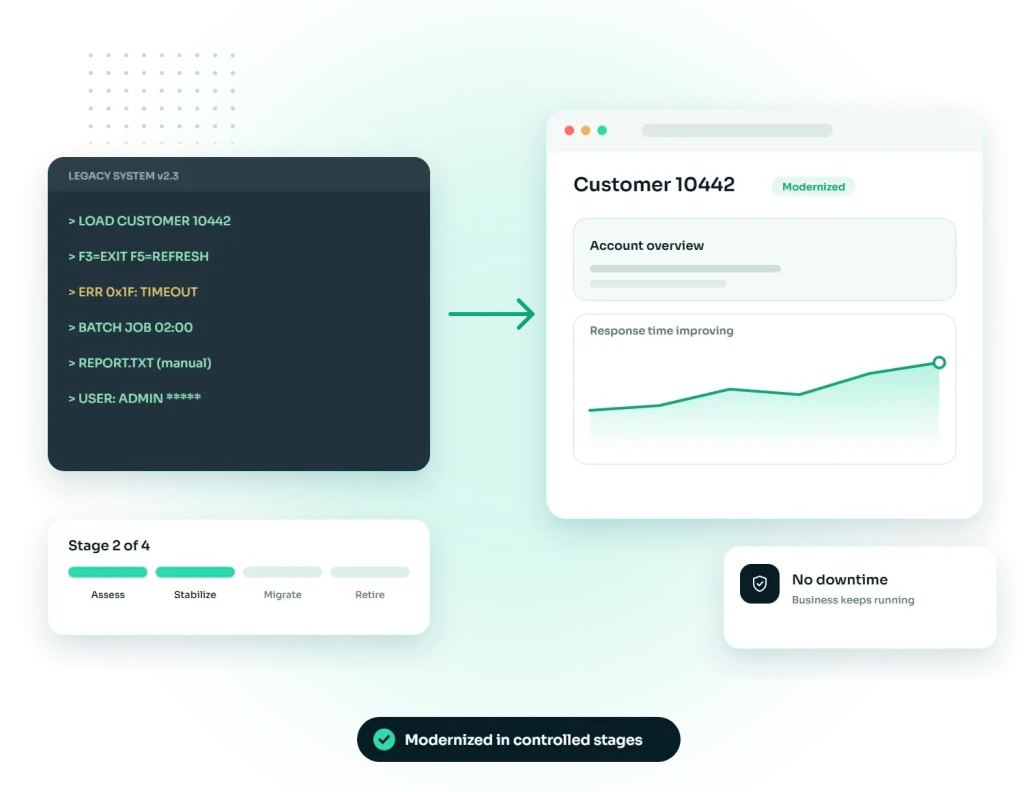
A legacy assessment combines code, architecture, infrastructure, data, integrations, incidents, and business dependency. We separate age from actual risk, then identify the parts that block change, raise operating cost, or rely on scarce knowledge.
Architecture and Code Modernization
Architecture and code modernization break large, tightly coupled systems into boundaries the team can understand and change. Work may include dependency upgrades, modular refactoring, service extraction, automated tests, and removal of duplicated or dead logic.
Cloud Migration and Replatforming
Cloud migration is planned around workload behavior, security, data, licensing, and operations. We compare rehost, replatform, and refactor options, then move components in phases instead of treating cloud hosting as the modernization outcome by itself.
UX and Frontend Modernization
Outdated interfaces slow users even when core logic still works. We redesign priority workflows, introduce accessible responsive components, and connect the new experience to stable services so front-end change does not require replacing the whole system.
Data and Integration Modernization
Legacy data and integrations usually carry the highest cutover risk. We profile sources, document business rules, build APIs or adapters, reconcile migrations, and give support teams clear visibility into failed or incomplete exchanges.
Ongoing Support and Evolution
Modernization continues after the first release through performance work, security updates, cloud optimization, dependency management, and planned replacement of remaining constraints. One roadmap connects immediate risk reduction with longer-term product goals.
Secure Modernization Without Losing Critical Business Logic
01
Security work begins with the weaknesses and constraints of the current environment. We review unsupported dependencies, identities, permissions, secrets, data paths, network exposure, logging, backup, and recovery. The target controls are introduced in stages so risk decreases during modernization rather than waiting for the final release.
02
AI-assisted analysis may help locate duplicated logic, dependencies, and missing tests, but senior engineers verify findings before code or migration decisions are approved.
03
Privacy, retention, industry, and contractual requirements become target-state controls and migration acceptance criteria. The final scope follows the data, jurisdictions, hosting model, intended use, and continuity needs.
Unsupported frameworks, manual releases, and scarce skills make routine change expensive. Legacy software modernization services reduce those constraints in priority order, allowing the business to gain value before every component reaches the target state.
Security Gaps in Unsupported Technology
Old dependencies may no longer receive patches, yet immediate replacement can create its own risk. We isolate exposure, upgrade feasible components, strengthen access and monitoring, and plan the remaining work against business continuity.
Critical Logic No One Wants to Touch
A legacy application modernization company must recover hidden behavior before changing it. We combine code analysis, user interviews, production evidence, and characterization tests to preserve useful outcomes while removing accidental complexity.
Modernization Without Business Disruption
We use APIs, parallel operation, phased migration, feature controls, reconciliation, and rollback to keep essential work available. Cutover decisions rely on agreed evidence instead of a fixed date that ignores operational readiness.
Our Legacy System Modernization Process
01
Legacy System and Risk Assessment
We assess code, architecture, infrastructure, data, integrations, incidents, operating procedures, and business dependency. Stakeholders identify essential workflows and unacceptable downtime. The resulting risk map distinguishes urgent remediation from change that can wait.
Deliverable:current-state assessment and modernization risk map.
02
Target Architecture and Migration Plan
Architects compare rehost, replatform, refactor, replace, and retire options for each component. The selected target state includes migration waves, data strategy, integration boundaries, security controls, testing, rollback, and ownership after release.
Deliverable:target architecture and phased migration blueprint.
03
Incremental Modernization Engineering
Engineers modernize in controlled slices, adding tests before changing unclear behavior. AI-first delivery supports analysis, documentation, and test generation, while senior reviewers assess architecture, security, data handling, and production changes.
Deliverable:working modernized modules with regression evidence.
04
Data and Integration Verification
We test business rules, integrations, performance, security, recovery, and data migration. Reconciliation confirms that records and balances remain complete. Open issues receive an owner, severity, and explicit disposition before each release moves forward.
Deliverable:verified release and migration evidence package.
05
Phased Cutover and User Adoption
Cutover occurs by module, user group, workload, or data set, depending on risk. Monitoring, rollback, user support, and parallel operation remain available until the new path meets agreed stability and adoption criteria.
Deliverable:controlled cutover and adoption plan.
06
Support and Continuous Improvement
After rollout, we monitor incidents, performance, cost, and user friction while retiring temporary bridges. The modernization roadmap is updated as real operation reveals new constraints, opportunities, or components that no longer justify replacement.
Deliverable:support baseline and remaining modernization roadmap.
Our clients
Generated over
$50M
in additional revenue for our clients
72%
Faster development with AI-assisted delivery
98%
Client satisfaction rate
Client Testimonials
How Much Do Legacy Software Modernization Services Cost?
Choose a focused application or a broader transformation program. Code condition, data, integrations, migration strategy, assurance, and continuity requirements determine the final estimate.
Software modernization services may include assessment, architecture, refactoring, interface redesign, cloud migration, data work, integrations, automated testing, security, deployment, and support. Legacy application modernization services focus that work on the constraints of an existing application. Intelisoft defines what to preserve, contain, replace, or retire before committing the business to one route.
Legacy system modernization services become necessary when unsupported technology, manual releases, scarce skills, fragile integrations, or rising operating cost block useful change. Software modernization services can be phased around the highest business risk. Intelisoft compares rehost, replatform, refactor, replacement, and retirement instead of treating a full rewrite as the default.
A legacy software modernization company reduces risk by recovering undocumented behavior, adding tests, mapping dependencies, and changing the system in controlled releases. A legacy system modernization company should also plan data reconciliation, rollback, monitoring, and parallel operation where needed. Each release has acceptance criteria that business owners can understand.
This work may start with a focused assessment and continue through several delivery waves. Legacy system modernization services take longer when data, integrations, continuity, or regulatory controls are complex. Software modernization services should show value between waves rather than making the business wait for a single final cutover.
Yes. Stable components can remain while high-risk modules, interfaces, or deployment paths are isolated and improved. Characterization tests preserve important behavior before refactoring. Strangler patterns, adapters, and staged migration can reduce disruption, provided the target architecture and temporary coexistence costs are explicit. The sequence follows business risk, not only technical convenience.
The plan identifies critical workflows, change windows, data controls, rollback points, and support coverage. Rehearsals and parallel runs are used where failure would be costly. Monitoring compares expected and actual behavior after each release, allowing the team to pause or adjust before the next wave. Business owners receive clear readiness evidence before each production move.
Cost depends on application size, code condition, architecture, data migration, integrations, cloud work, assurance, and continuity needs. Estimates should separate assessment, delivery waves, licenses, and ongoing support. Intelisoft prices the agreed scope after identifying major dependencies and the evidence required for a safe release. The proposal should also explain contingency and post-release support.