Our custom healthcare software development services turn a validated idea into web, mobile, or cross-platform software with a scalable architecture, accessible UX, and measurable product goals.
Patient and Provider Portals
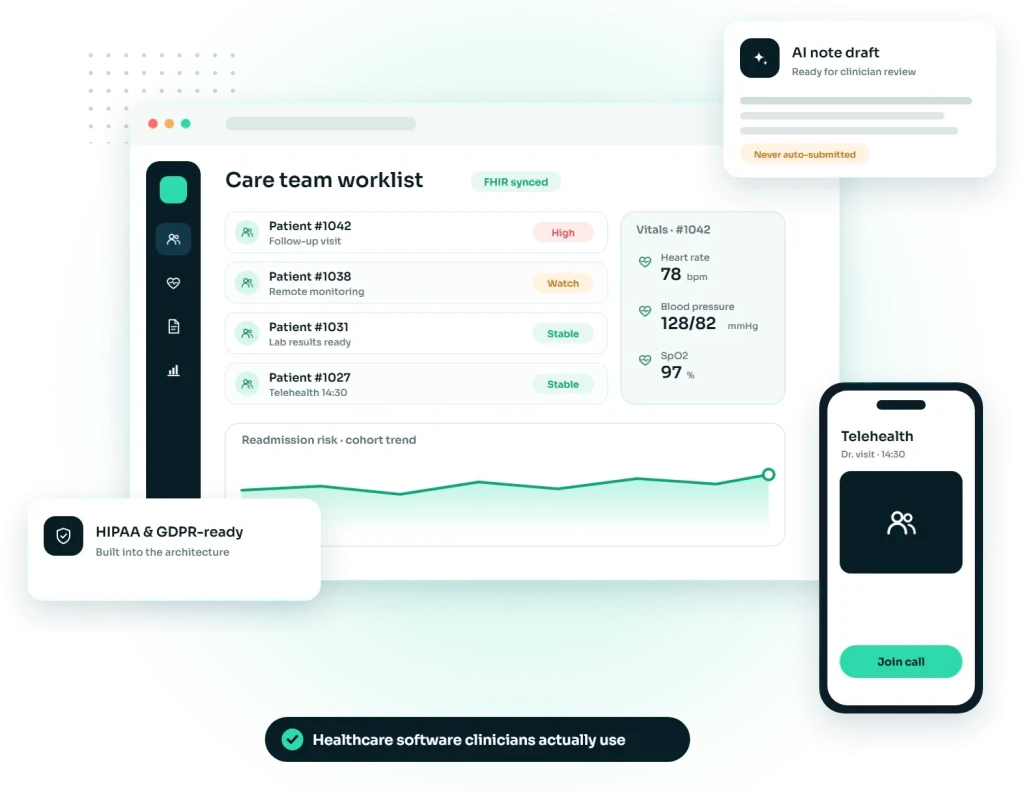
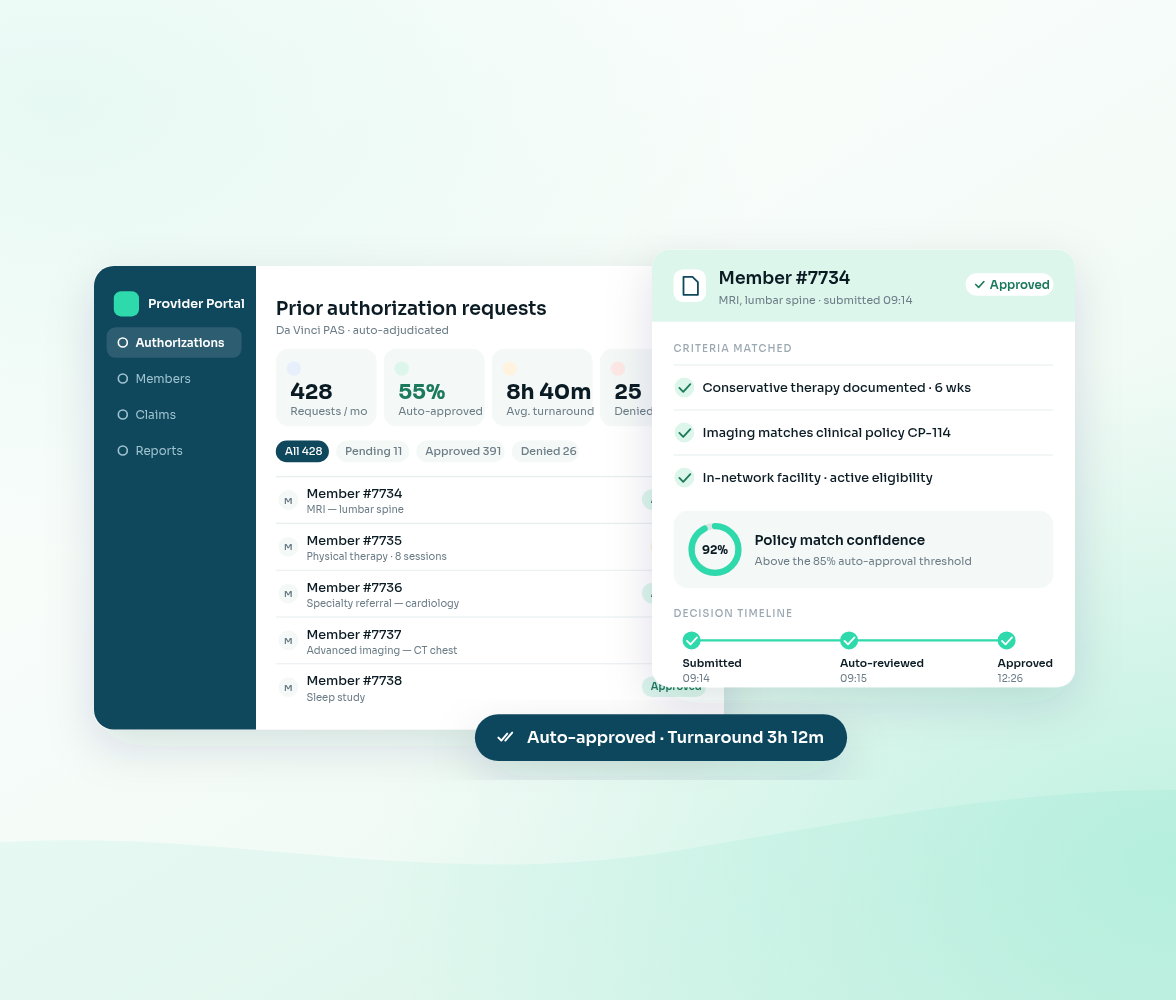
Medical software development services for patient and provider portals bring appointments, intake, messages, results, referrals, and care plans into one secure workspace.
EHR and EMR Solutions
Custom medical software development can extend existing health record environments through focused clinical applications, workflow extensions, and data services instead of duplicating them.
Telemedicine Platforms
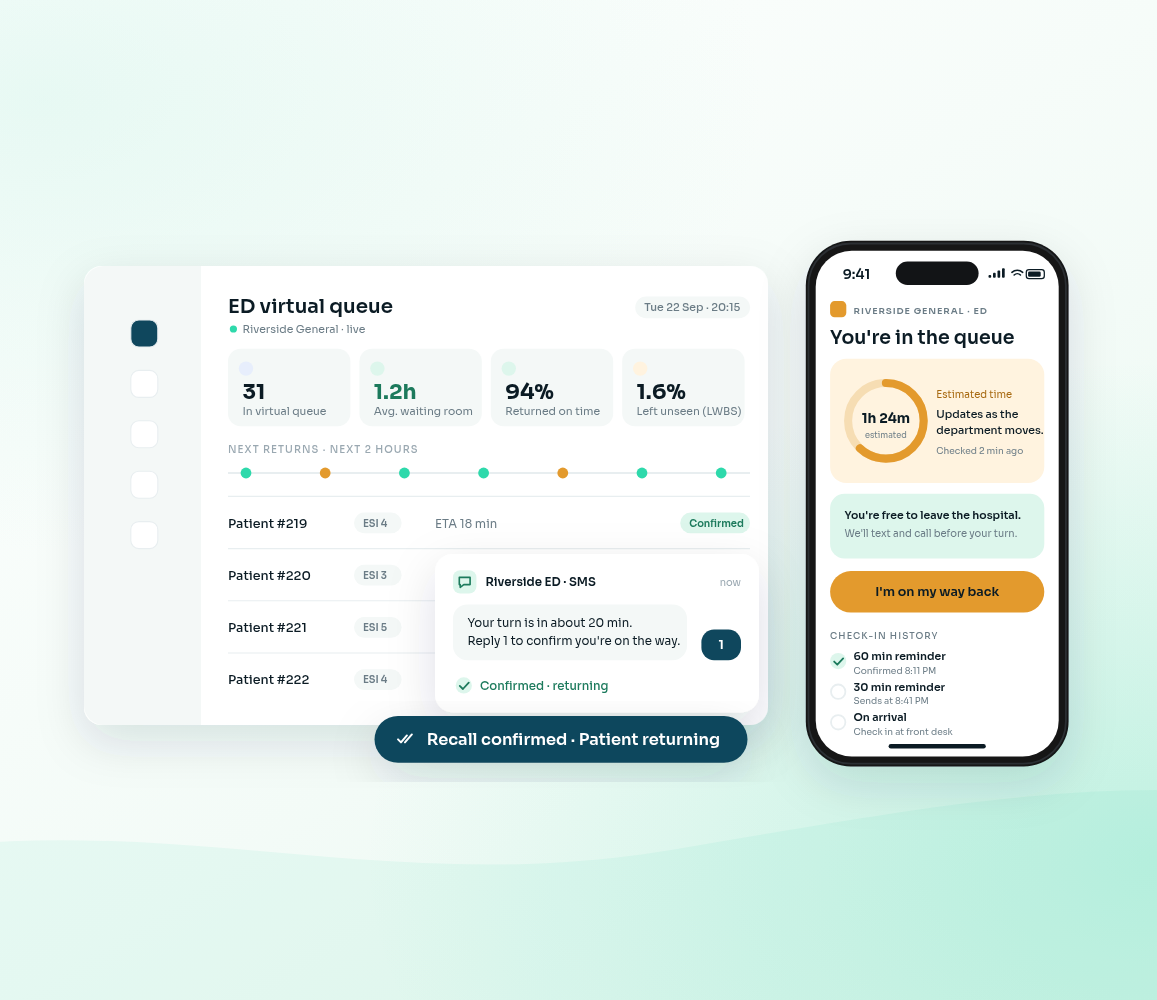
Video is only one part of a virtual visit. The product also needs booking, consent, clinician tools, reminders, payments, and working connections to other systems.
Healthcare Data and AI Solutions
Analytics, automation, and AI earn their place by solving a defined problem. Data access stays controlled, and consequential decisions remain visible to people.
Modernization and Support
Our custom medical software development services reduce legacy constraints through phased re-platforming, API enablement, cloud migration, performance work, security hardening, and dependable post-launch support.
Healthcare Software Development Services and Solutions
Healthcare Software Built Around Security and Compliance
01
Security decisions should help care teams do their jobs, not put another obstacle in their way. We trace where sensitive information enters the product, who needs it, and what happens when a service fails. That work informs access rules, encryption, audit trails, recovery tests, and secure engineering practices.
02
A US delivery plan can cover applicable HIPAA safeguards and, where the software has a medical purpose, FDA considerations.
03
In the UK, the same planning accounts for UK GDPR duties and relevant MHRA guidance. The final compliance scope follows the intended use, jurisdictions, deployment model, and actual risk of the product.
Disconnected tools create duplicate work, inconsistent data, and incomplete context. As a custom healthcare software development provider, Intelisoft defines integration boundaries, canonical data models, and resilient exchange patterns across EHR, laboratory, imaging, billing, and patient systems.
Complex User Workflows
Generic software often adds unnecessary clicks, manual steps, and workarounds. We study real user roles, decisions, and dependencies, then simplify navigation, task routing, handoffs, and exception handling across everyday healthcare workflows.
Sensitive and Regulated Data
Health information raises the requirements for privacy, retention, access, and accountability. We make safeguards testable and ensure the resulting evidence remains connected to product design, software delivery, validation, and ongoing operations.
Legacy Constraints
Replacing a critical platform overnight is rarely practical. A custom healthcare software development vendor should clarify ownership, scope, and delivery evidence while using APIs, staged migration, side-by-side validation, and observability to modernize systems in controlled steps.
Healthcare software development process
01
Discovery and Risk Framing
The cost of custom healthcare software development starts with understanding what must improve, for whom, and how success will be measured. We map workflows, data boundaries, regulatory requirements, integration dependencies, and major delivery risks before development begins.
Deliverable:validated scope and risk map.
02
Product & Solution Design
User journeys and prototypes are translated into a practical product structure supported by architecture, data contracts, integration requirements, and security controls. Features are prioritized around business value, user needs, technical dependencies, and a realistic first release.
Deliverable:build-ready product blueprint.
03
Iterative Engineering
Cross-functional teams turn approved priorities into tested software increments through structured development cycles. Functionality, integrations, and technical decisions are reviewed continuously, while regular demonstrations help stakeholders validate progress and adjust priorities before the next development stage.
Deliverable:working, reviewable software.
04
Verification & Launch
Before release, the software is verified across core functionality, integrations, performance, security, accessibility, recovery scenarios, and everyday operational workflows. Identified issues are addressed, launch requirements are confirmed, and the system is prepared for controlled deployment.
Deliverable:evidence-backed release package.
05
Deployment & Adoption
The approved solution is introduced into the target environment with attention to configuration, integrations, data readiness, operational procedures, and user adoption. We support the transition from development to real-world use and help teams establish stable processes around the new software.
Deliverable:production-ready deployment and adoption plan.
06
Support & Evolution
After launch, we monitor system behavior, resolve issues, strengthen performance, and evaluate opportunities for further improvement. Product decisions are informed by real usage, operational feedback, changing requirements, and business priorities to support the software as needs evolve.
Deliverable:support baseline and prioritized product roadmap.
Our clients
Generated over
$50M
in additional revenue for our Healthcare clients
72%
Faster development processing with AI
98%
Customer satisfaction and strategical success
Client Testimonials
How Much Does Custom Healthcare Software Cost?
Choose a reference solution to see what a typical first release can include. Final scope, integrations, security, and regulatory requirements determine the estimate.
There is no fixed package. One team may need help testing an idea; another may arrive with a live product that is difficult to change. Work can span discovery, product design, architecture, web or mobile engineering, interoperability, testing, deployment, and support. Intelisoft selects the pieces that match the product’s current stage and the next useful outcome.
First we establish what data is involved, why it is used, who can see it, where it lives, and which jurisdictions matter. Those answers shape access, encryption, logs, retention, recovery, third-party dependencies, and records of key decisions. The organization remains responsible for its legal obligations and should bring in qualified counsel for legal interpretation.
Yes. We start with the target system’s real interface: its authentication, data model, rate limits, and failure behavior. The connection might use FHIR, HL7 v2, a vendor API, an interface engine, or secure file transfer. Beyond the happy path, we define retries, bad-data handling, monitoring, reconciliation, and who investigates failed exchanges.
Yes, including connected applications, clinician tools, data services, and Software as a Medical Device. Intended use and target market determine how the product should be classified and what its lifecycle needs to produce. We establish the expected documentation, verification, risk controls, and regulatory path before planning the architecture and releases, so engineering evidence remains useful beyond the development team.
Yes. Before recommending a roadmap, we inspect the code, architecture, infrastructure, data, integrations, security posture, and operational dependencies. The answer may be a new interface, stronger APIs, cloud changes, data migration, modular replacement, or targeted performance work. We sequence that work by risk and value while keeping essential workflows available.
A focused first release may take several months. A platform with difficult integrations, migration, or regulatory work usually needs several phases. Rather than quoting one generic duration, we use discovery to turn scope and constraints into milestones, assumptions, dependencies, and decision points. The resulting schedule can be managed, challenged, and revised as the team learns.
Launch changes the work; it does not end it. Support may cover monitoring, incidents, defects, security updates, performance, cloud costs, and changing integrations, alongside planned improvements. Before handover, we agree who owns each environment, how priorities and escalations work, and which operating measures matter. That keeps routine product work from turning into a series of emergencies.